mercoledì 8 agosto 2007

All the world in just one night...


...this is the theme for the 2007 edition of "La Notte Bianca"!
Don’t miss this important cultural event for Saturday September 8th!!!
The Notte Bianca is a great event, always characterised by multidisciplinary characteristics, walking the streets of Rome will be like walking the streets of the world..
...on a journey of discovery to near and distant countries, to the sounds and the cultures of the world, with performances and artists from the five continents and Italian productions that have adopted cultural contamination as their fundamental theme. The programme (get all information here) includes performances, concerts, plays, dance shows, magic and circus arts, contemporary art installations, fireworks, even a concert of church bells, all characterised by tradition and experimentation, merging together for one night an ensemble of artistic capabilities, cultural scope, knowledge, techniques and ways of expressing art and entertainment, all very different one from the other, and that is both multifaceted and harmonious!
You can be sure... we'll be there, won't you? ;-)

lunedì 6 agosto 2007

The crypt of the Capuchin friars

These are the days in which i would like to write & speak english seriously!But, fortunately, google translater come to me in aid...and today i'll be able to start the week talking about something.... grisly! The crypt of the Capuchin friars.
In this crypt the Capuchin friars, so called thanks to their hood attached to thei religious habit, were buried until 1870. Is estimated that there are the rests of approximately 3.700 persons whose bones were arranged all along the walls !! Over the years this place of interment, prayer and reflection for the capuchins was transformed from a burial place into the work of art that it is today. Also the Marquis De sade visit the cryp in 1775 leaving an evocative descrition of it, as many other foreign writers made after him.
Inside the crypt can be distinguished five different rooms:
1. The crypt of Resurrection
On the rear wall, various parts of the human skeleton form a frame representing the picture of Jesus commanding Lazarus to come out alive from the tomb. The Christian belief in the Resurrection provides the key to interpreting this work of funeral art.
2. Crypt of the skulls
In the tympanum, of the central niche, an hour-glass stands out with wings made of shoulder-blades representing that the time not only passes, but it flies. On the side walls you can see two Capuchins resting in curved niches. In the corridor vault, a lantern hangs from an eight-pointed star.The vault in the passageway is enhanced by a new element: a winged skull, its wings fashioned from shoulder-blades.
3. Crypt of the pelvises
The side walls contain two Capuchins serenely reclining in an arched niche. The rear wall has three niches with Capuchins leaning forward: the two at the sides under an upturned arch, while the middle one rests beneath a large "baldacchino" made of pelvises, from which hangs a fringe of vertebrae. The central "rosette" in the vault is formed by seven shoulder-blades, with hangings made of vertebrae. On either side, the decoration ends with crosses bearing the instruments of Christ's passion: the spear and the sponge on top of a staff
4. Crypt of the leg bones and thigh bones
The side walls each have four niches occupied by a Capuchin, standing and vested in the habit. Along the rear wall, the central block is a richly imaginative composition: up above, a cross enclosed in a circle; underneath, the Franciscan coat-of-arms: Christ's bare arm crossing the clothed arm of St Francis, surmounted by a crown of vertebrae. In the ground, 18 crosses mark the graves of various friars. The central oval frame in the vault contains an arrangement of jawbones decorated with vertebrae and, on either side, two large flowers made of shoulder-blades, with hangings of vertebrae. The corridor vault has three eight-pointed stars, a massive lantern hanging from the central one.
5. Crypt of the three skeletons
The two small skeletons against the rear wall are holding in one hand a skull with wings made from shoulder-blades. Impressed into the center of the vault there is a delicate skeleton enclosed within an aureole, the symbol of life coming to birth. In its right hand it holds a scythe, symbol of death which cuts down everyone, like grass in a field, while its left hand holds the scales, symbolizing the good and evil deeds weighed by God when he judges the human soul. The corridor vault is very rich and varied: four small five-pointed stars surround the other eight-pointed star from which the lamp hangs. On the wall opposite the door you see the striking design of the clock, its single face indicating the continuity of life, in time and in eternity.
"All praise be yours, my Lord,for Sister Death,from whose embrace no mortal can escape.Woe to those who die in mortal sin!Happy those She finds doingyour most holy will:by you, Most High, they will be crowned".
(St Francis of Assisi).

A complete Guidebook is available from the friar on duty.
Via Vittorio Veneto, 27
Opening hours:9-12 a.m.; 3-6 p.m.
Closed Thursdays

venerdì 3 agosto 2007

The most ancient bell and the smallest bell tower

This blog adventure started to help tourists in discovering the city's unknown beauties, small pearls lost in the Eternal city, made invisible by traffic jam, chaos and people coming & going. That's why we want to add a new tag called "A Night in Rome neighborhood" to show you the neighborhood of our apartments and help our guests in imaging how beautiful is Trastevere...
One of the unknown secrets of Trastevere has a really small size...
Where: in the ancient hamlet of Trastevere, in Piazza in Piscinula (in front of the Tiberina island). Turn your back side to the Tiber river and look just in front of you on the left side of the square, what you see is the church of Saint Benedict in Piscinula.
The church, whose name “in piscinula” comes from the presence of some thermal swimming pools rose on the public square during the roman age, rises on the rests of the Aniciorum Domus, the ancient dwelling of the Anicii’s family, to whom belonged Saint Benedict, father of “monachesimo”.
According to the tradition, Saint Benedict lived here during his stay in Rome in order to undertake the studies that, as all of us know, were interrupted by his decision to withdraw itself to Subiaco to lead life as a hermit.
What is sure is that the church, which shows ancient paintings of 1300, rose between the end of 1000 and the beginning of 1100, but nowdays it shows a different facade because it was changed in 1800 (look the first and the last image). The most interesting feature of the church are the bell tower and its bell. Both realized in pure “Romanico” style they are the smallest and the most ancient in all Rome, so lot that, set between the roofs, they seem nearly like toys !!!
The bell has a diameter of just 45 centimeters (like a pc’s keyboard!) and is also very ancient, much more than the bell tower itself ! Infact the date engraved on the bell tells: Anno Domini Millesimo Sexagesimo IX (1069).
This is, probably, the only one bell escaped from the pillage of the 1085 when the great part of the city bells desappeared. Probably the small dimension of the bell saved it from the greed of the plunderers, attracted by the bigger ones and by their powerful sound!!

If you want to take a look on the church it is opened only on Sunday morning and during the religious festivity.

mercoledì 18 luglio 2007

La festa dei Noantri

The “Madonna del Carmelo”, in Rome, has assumed, in the years, several peculiar connotations becoming, around 1920, the festivity of “de noantri” (noantri, in roman dialect, means “we other” referring to people who live in Trastevere district regarding those who live, instead, on the opposite side of Tiber river!!). A legend tells that some fishermen, fishing on the Tiber river towards the half of July of a no-well known year, collected, from the river, a case which in the inside hidden one precious statue of the Madonna.
The fishermen, delighted by the beauty of the Vergine, hurried to transfer it in the sant'Agata church where still today she is. From that day, about on the third Sunday of july the Madonna goes on procession from San’Agata church through all the alleyways of Trastevere in order to reach saint Crisogno church, where she stays for eight days at the end of which she comes back to sant'Agata.
The procession was anciently organized by the company of the "vascellari", the potters, but today it’s a task of the “confratelli della Arciconfraternita del Ss. Sacramento e Santa Maria del Carmine”, who, with their white traditional frock, carry the statue throughout Trastevere.
This celebration, a time characterized by the presence of the "vascellari" with their jug overflow of wine, is today characterized by the pagan festivity called festivity of “noantri”.
During these days all people of Trastevere stand to this public party in a climate of common joy with open taverns, manifestations, wondering theatres and open markets. For a week Trastevere become like a small village with all tourists surprised by the caos and confusion and often unware on what is the Christian recurrence.... remember always: FESTA DEI NOANTRI la festa dei Trasteverini!!
Have much fun!

martedì 17 luglio 2007

When Mastro Titta crossed the bridge...

Public executions in the 19th century -Rome-
"Viengheno: attenti: la funzione è llesta..."
(Here they come: pay attention: the ceremony is short...)

These are the opening words of one of several sonnets by the famous dialect poet G. G. Belli inspired by executions that took place in Rome.When the city was ruled by the papal authority, the so-called 'Pope King', up to 1870, public executions were one of the common people's favourite happenings, attended by crowds, who found this unholy practice not only amusing, but even took their sons to witness the event for educational purposes, on the very moment the blade fell down, they used to give the kid a slap, as a tangible reminder of what one day might have been their own fate if they had got into trouble with justice!From 1796 to 1864 the protagonist of these frequent executions in Rome was: Giovanni Battista Bugatti, whose nickname Mastro Titta, became legendary and a synonym for 'executioner': during his 70-year long activity, he performed 516 executions, or justices, as they used to be called.
Although he professed one of the most outrageous activities, Mastro Titta carried out his duty with a certain detachment, a traditional roman attitude towards ill fate. He is even known to have sometimes offered the condemned a last pinch of snuff (see the photo above), almost as to say don't blame me for being here today, or cheer up: it won't take long, I'll do a neat job!!Mastro Titta lived on an official job: he was an 'umbrella-painter', an activity for which he ran a shop next to his house in Borgo district, on the western side of the river Tiber, next to the Vatican, where via degli Ombrellari (umbrella-makers street) still exists today. Due to his other more occasional 'work', for the sake of his own safety, he was not allowed to enter the city's central districts (i.e. on the opposite side of the Tiber), except officially, for the well-known reason and so on every crucial day he wore his scarlet cloak and 'cross the bridge', this meant that somebody was going to lose his head very soon….
Public executions used to be held on fixed spots, one of these was the small square at one end of the bridge in front of Sant'Angelo Castle, whose charming view was still not enough to deaden the cruel show it used to host.
Another place was piazza del Popolo. Still today, a plaque set in 1909 by a democratic association remembers two patriots sentenced here in 1825, their capital punishment being ordered by the pope, without evidence. The story of the two patriots also inspired movie director Luigi Magni for the making of one of his best known titles, The Conspirators (original title: Nell'anno del Signore, 1969).
Another typical feature of the gloomy cerimony was the procession of friars who accompanied the condemned up to the scaffold, wearing a black cowl with a pointed hood.They belonged to the Confraternita della Misericordia, "Brotherhood of Mercy", a centuries-old congregation founded in Florence. Their see in Rome was by the church of San Giovanni Decollato ("St.John Beheaded", i.e. St.John the Baptist), located in a narrow street by via dei Cerchi, another spot where executions took place in the 1700s and 1800s.
The congregation was in charge of delivering religious consolation to the condemned; after the execution, the same friars also carried away the corpses to the church's cloister, where they buried them.By an ancient privilege, granted by pope Paul III in 1540, each year the Brotherhood of Mercy had the right of freeing one convict sentenced to death: the choice was carried out by gathering information about the several prisoners, about their crimes and their trials, by asking the victims' families for forgiveness (the convict could not be freed without their permission), and by finally holding a ballot among the members, to choose which prisoner was more worthy of being saved, and when to hold the ceremony. On the given day, a procession of friars would march up to the jail, where the chosen prisonery would be officially handed over to them. The congregation would have then found the man an honest job or, in the case of a stranger, would have given him some money to travel back home.
(Symbol of the congregation, a head on a plate)
Memories of the aforesaid rituals and ceremonies are now kept in the congregation's Historic Chamber, by St.John's church, open to the public once a year, on June 24, the saint's own day.
What is left of Mastro Titta, instead, besides his legendary fame, is the scarlet cloak that the executioner used to wear on official occasions, when he was allowed to 'cross the bridge'; it is now on display in Rome's Criminology Museum.

lunedì 16 luglio 2007

Il porcino della Minerva

Romans adore playing with words and give picturesque name to the monuments...
For example, look at the image below….
Look at the animal who is carrying the obelisk, may you seen something like a piggy?!
No, absolutely no.
The big nose make us sure…is an elephant, without a dubt!!
Well, the question is: if the image represent an elephant, why ever do romans call the monument “Il porcino della Minerva”(the Minerva's piggy)?
Beware: “porcino” cames from the roman dialect and means a piggy; today, for phonetic reasons, we usually call it “pulcino” that means a chicken (in roman dialect Pulcino is pronounced Purcino, i.e. very similar to the nickname). A piggy, a chicken but…where is the elephant?!
Absolutely misleading! ;-)
The monument stands in piazza della Minerva, just behind the Pantheon, right in front of St.Mary Over Minerva, a Dominican church whose name comes from the fact that it was built over the ruins of a temple dedicated to Minerva, roman goddess of knowledge.
In 1665, a small obelisk inscribed with hieroglyphs was discovered in a garden belonging to the Dominican monastery. For this reason pope Alexander VII decided to have it raised in front of the same church. To choose a base for the obelisk, a number of designs were presented to the papal commission. One of them was by a Dominican priest, Father Domenico Paglia, who was also an architect. According to his project, the obelisk would have rested over six small hills (the same hills featured in the crest of the Chigi family, whom Alexander VII belonged to), with a dog on each corner; the dog is the symbol of Dominican priests, the name cames from latin Domini canes, i.e. "the Lord's dogs", to remark their fidelity.But the pope rejected this design, as he wanted the statue to be a symbol of the Holy Knowledge, to recall the original dedication of this site. The famous artist Bernini was asked to devise a different solution. He presented several drawings, among which one featuring an elephant
The pope chose this one, as an allegorical representation of fortitude: "...a strong mind is needed to support a solid knowledge", reads the inscription on one side of the base.
In the sculptor's original plan the obelisk would have fully rested on the elephant's legs, without a stand below the animal. But Father Paglia, who was rather envious for having his project been rejected, argued that according to traditional canons, by which no weight should rest vertically above an empty space, as it would not be steady nor long-lasting, a cube should have been inserted under the elephant's belly
Bernini strongly opposed this alteration but the pope decided to have the cube added to the statue all the same.The sculptor also tried to disguise the rough cube by adding a saddle-cloth to the elephant's back but, despite his attempt, the change still gave the statue a rather heavy look. For this reason, which makes the elephant resembling a pig, the people of Rome nicknamed the monument Porcino della Minerva ("Minerva's Piggy")!
However Bernini took revenge upon his rival: in the final version of the statue, carved in 1667 he drew the elephant pointing towards the Dominican monastery with his rear end, the tail slightly shifted to the left, in the attitude of saluting Father Paglia and the other Dominican friars in a rather... obscene way!

venerdì 13 luglio 2007

Città di Noto (Sicily)

Coming back from my sicilian holidays i want today show you a beautiful pearl of the Mediterranean sea......

-The city of NOTO-
Noto town hall
Noto is a living book. Every corner, even the hidest, speaks about history, people, colours, shows you capitals, baroque friezes, churches and noble palaces. There are cities and countries who recall the purity and the harmony of art. Noto, is one of them; with its architectural and cultural beauties the visitors has the feeling to be in a temple of living stones.

Panoramic view of the city
The city, honoured recently by UNESCO with the title of "cultural patrimony of humanity", represents the emblem of wealth and luxury in the Baroque age in Sicily. Palaces are maiden of yellowish stone, their colour changes during the day like only the sun can do, is an unexpected treasure, scattered in the territory, containing stories of ancient civilizations.

Chiesa madre San Nicolò after the fall 13 of march 1996
The church of San Nicolò it has been opened again on june 2007 after a long restoration lasted more than 10 years, after the fall happened in the 1996. Infact, if you see the photo above the church it hasn't get the roof. Fortunately the fall didn't regard the front of the church that, probably thank to a miracle, didn't break down! The front and the dome (that part which didn't collapse) are certainly the best part of the church while the inside aisle, even if re-constructed exactly as it was before the fall, is not exceptional considering that all ancient paintings they have been destroyed.
Church of San Domenico
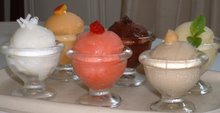
If you decide to spent one day in this beautiful little city (how to get look here) the opportunities not to miss are: a visit to the centre of the city (look here for itineraries) enjoying its history and its popular traditions, a plunge into the blue sea, parades and village festivals. Among these don't forget the beautiful Flower Festival the last week of may! After 22 years this Festival has become a real tradition and custom so lot that the Flower Festival of Noto is, by now, a fixed event, rich in appointments, shows, assemblies and costume parades! When in Sicily don't forget to try the yummy "granita siciliana" and "brioches col gelato"! ;-)

Be amazed by the art, the culture, the traditions, the sea and the sun of one of the most beautiful city of Sicily.
I'm sorry but many links are in italian i could no find them in english, sorry!