mercoledì 17 ottobre 2007

Non un caffè ma il caffè!

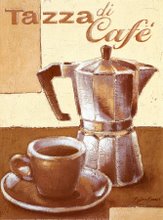
A day spent wandering in the city can not ignore what the romans call the… pausa caffè! This is not a common and banal coffee break but a real rite that the Romans love to do, over and over again, during the day. For us, the coffee is no longer just a drink, but an art that reflects a way of life and for this reason has billions of variations… macchiato, corretto, ristretto, lungo, in tazza piccola o grande, al vetro, con la schiuma e senza.....
You have to know, before entering in a bar, that:
-Caffè macchiato: is a cup of coffee with a drop of cold milk
-Caffè corretto: is a cup of coffee with a drop of liquor (generally grappa)
-Caffè ristretto: strong coffee
-Caffè lungo: less strong
-Caffè al vetro: in a little glass cup (the experts say that the taste changes…)
-Caffè decaffeinato: without caffeine
-Caffè espresso: is the one made in the bar
-Caffè moka: is the one you made at home with our cofee machine
This is the right address, for your pausa caffè, when you are wondering near the Vatican:
Castroni via Cola di Rienzo 196 Roma Vatican
We like this place much because it not only offers a really good quality of caffee, but also has an excellent range of international and italian food products as pasta, tea, chocolates, pasta dressing….
A real pleasure... not only for the eyes!

lunedì 1 ottobre 2007

The cannonball of the miracle

Chiesa di San Bartolomeo all'Isola -Isola Tiberina-
In the chapel of the church of Saint Bartholomew upon the Isle, there is a large (14cm diameter) cannonball lodged in the wall where it struck it during the siege of Rome of June 1849. When it hit the building it was full of people , who went miraculously untouched. The cannonball, known for this reason as "of the miracle" was left in the wall as a "memento" of the event.
Miraculous Rome!

martedì 25 settembre 2007

Vecchia Roma

Yesterday Rome from Alinari
When you're in Rome don't miss the apointment with the photos in black & white of the ancient Rome at the art gallery of the Alinari Bros in Via Via Alibert, 16/A. Without a doubt i think this is the best way to get a present of the Eternal City!
Yesterday Rome from Alinari
The Alinari photographs are contact printed from the original glassplate negatives housed in the Historic Archive. This manual technique of reproduction is the same used during the 19th century. The prints are made in black and white or they can be sepia toned and they can be also mounted on wood. These faithful reproductions are printed on special photographic paper and manually created in order to offer a product that is of unique quality and prestige. Is also possible to buy on line but if you're in Rome spend time there.... is not a lost time!
Tempio di Vesta as it looks today

lunedì 24 settembre 2007

The river under the alter

Some people say that Rome has not a big historical center...and i seriously ask my self "which Rome have you ever seen?! not mine sure!". Sometime i think we should have 3 life to know Rome's beauties...one in order to see what is "over" our head, one to see what is "in front" and one to see what is "under". But life is only one so, when you're wandering in this beautiful city don't forget to look over, in front and under all at once! Here is an example:
The church of Saint Clement. Over: the beautiful and restored frescos of Masolino da Panicale and the 12 th cent. mosaics of the apse.
Under: two layer of history. The older church built in the fourth century and dedicated to San Clemente, the third pope after St Peter and underneath it again, the roman buildings which are, themselves, made up of different "strati".
In front: when you look in front of you, at the alter, beware and listen....under the very ancient basilica of Saint Clement there is a small underwater river that has a little waterfall! Onetime they were both visible but in late, for reasons of prudence, they were hidden by a wall through which one can still today distinctly hear the noise of running water.
Don't forget...always over, in front and under!

giovedì 20 settembre 2007

I famosi "canterani" di Piazza Sant'Ignazio

Today, in this posts, i would like to join two of my favourite topics: the love for my city and that one for the furnishings. I didn't believe, until few moments ago, that was possible for me join these two subject, but i was wrong!
Have you ever seen that beautiful furniture characterized by rounded and delicate shape the so called style of "Luigi XIV"? Would you have never thought to find, in the center of Rome,
a district where the building have the same shape of that furniture?! Try to imagine.... giant drawers, four plan high!! And well...Rome astonished me once again....we are in the district called "Pigna", in the square of Sant'Ignazio.
The buildings that look onto the incredibly beautiful square of Sant'Ignazio are the famous “canterani”, thus depreciatively named by Filippo Raguzzini because they were made in the shape of the furniture of that time (1650-1750). Despite early critics they are now much admired.
To have an apartment in one of those "canterani" is today a sign of distinction, but few people can today boast themselves for having a similar fortune!!
Tastes change, what today is ugly will become beautiful tomorrow!

Sacra Rota Romana

Two posts ago talking about the "Rota Porphiretica" an "anonimo"reader gave me the idea for this post. I have to admit, i never known, until today, the reason why the Tribunal of the Holy See is called "Sacra Rota". Is a really serious fault for someone who lives in Rome from the birth! Today i have filled up this gap thanks to a blogger friend! :-)
The Tribunal of the Rota Romana was essentially named as such because the judges, called auditors, originally met in a round room to hear cases (look at the picture).
Thank you very much to all those who want to suggest me ideas to talking about!
WELCOME!

mercoledì 19 settembre 2007

The cathedral … that is not Saint Peter’s

Did you ever ask yourself who has been the first Pope of the history?
Who is the first ring of this long long chain of Popes?
The first was the Apostolo Simone
(later called Pietro, dead in the 69 a.c.).
Inside the Basilica of Saint Peter there is the pontifical throne said to be of him (said to be....!), the first Pope. It is placed in a colossal case that rests against the wall of the apse and was built by Bernini in bronze, marble, stucco work, gold and glass, and is sustained by four saints: St. Ambrose and St. Augustine at the front, and St. Anastasias and St. John Crisosthomus at the back. The composition is so masterful that it must be seen during a holiday in Rome!
Further to careful analyses conducted during restoration carried out by a special commission of experts nominated by Pope Paul VI (1963-1978) in 1968, it turned out that the pontifical seat – known as the Cathedral of Saint Peter – only dates back to the IX century! It is too "recent" to belong to Pietro!

It is probably the Carolingian throne brought to Rome by Carlo il Calvo in 875 when he was crowned in the basilica by Pope Giovanni VIII (872-882).