mercoledì 13 agosto 2008

Buon Ferragosto!!!

“Ferragosto”
is a popular midsummer holiday which coincides with the religious feast of the Assumption of Mary into heaven celebrated on August 15.
The most ancient origins of this event are recognized in the so called “Consualia” from the latin “Conso” god of the stored harvest. In the ancient roman times, during this day, people used to exchanged gifts with the hope of having “Bonas ferias consuales” (a sort of have a "prosperous year").
The name of the month "August" has its origin in the ancient rome back to the Emperor Caesar Augustus, this month was infact dedicated to him and the wish “Bonas ferias consuales” changed its formula in “bonas ferias augustales”, our modern "Buon Ferragosto !!".
It was the emperor's decision to combine in a single summer festivity a whole complex of festivities so called Feriae Augustii or Feriae Augustalis.
Subsequently, the Midsummer Feast taken a predominantly religious fold. On this occasion many spectacular processions were held during the night, an old image of the Savior was transported in the old city of Rome from the chapel of San Lorenzo in Laterano, today inside the sanctuary of Scala Santa, to the basilica of Santa Maria Maggiore. The image of Christ proclaimed "Acheropita" (not painted by human hand but, according to tradition, by angels) was taken by the Pope in person in the evening of August 14, placed on a canopy and transported all around the old city in the light of torches.
The procession was deleted around the second half of the sixteenth century (1550).
Subsequently, the Roman Ferragosto was linked to profane rituals such as racing horses, fighting bulls. There were also games, particularly uncivilised, as the "strappacolli alli paperi" (strangle the duck) which were abolished by Pope Innocent XI, in 1681.
Bonas Ferias Consuales !!
BUON FERRAGOSTO A TUTTI !!!!
Bonas Ferias Augustales !
HAVE a GOOD MIDSUMMER FEAST !!

sabato 9 agosto 2008

Under a falling roman sky

-ROME -

The night of wishes is arrived, the one during which we all turn our gaze up to the sky in the hope of seeing the stars fall down!!!
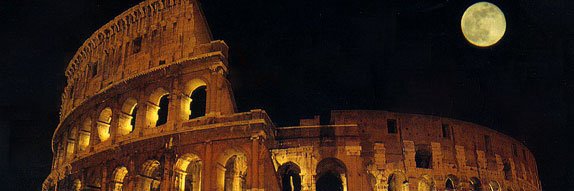
According to tradition would be the tears that San Lorenzo poured on the day of his torture that roaming the whole universe until they fall to earth, usually the night of August 10.
This year makes an exception, it will not be the August 10 the brighter night, but the one between tomorrow and the day after (August 11-12).

Beware, remeber yourself to be turn your gaze up to the sky again the night between August 16-17 there will be an “eclissi” of the moon, something like this......

mercoledì 23 aprile 2008

Nuove scoperte!

Rome, standing at the bus stop waiting for an invisible bus, the question is: “Why romans don’t have 5, 6 or 7 metro lines like the other capitals of the world?”
The answer is: “Because Rome hides a second ancient city under the ground level!”
(Under Venezia Square)
At Every step you take, on the ground level, remember that you are walking on a history of thousands & thousands years old!
In this post I want to show you what is hidden behind the curtain in Piazza Venezia ( excavation for the implementation of the line metro C, our 3rd line! YUPPIES!!!!!)
Archaeologists have found, one above the other, the different layers of the ancient Via Flaminia, from the ancient roman layers up to the most recent. This ancient route should have started from the current Fori Imperiali, ran around the Campidoglio and then pointed to Campo Marzio cutting, exactly in the half, the current Piazza Venezia. Opened in 223 A. C. by Caio Flaminio became one of the most important ancient Rome way but it was much used always during the Bizantine time and during the Middle Age, then restored during the Renaissance and used up to the 1800: these are the different layers that are returning back to the light under Piazza Venezia.
Look at what is coming back to light, right now………
(Furnace for the production of glass and fragments)

(Glasses of the Medioeval age)

(Metallurgical plant)

(Metallurgical fragments)

(Houses of the Medioeval ages)

(Chafing dish, IX century founded in a home)

(Typical steet of the Medioeval age)

(Medioeval furnace)

(Renaissance age)

lunedì 31 marzo 2008

Il Supplì

SLURP!!!!
The so called “supplì” fall among the myriad of snacks, and culinary "intermezzi" of which is rich the gastronomic Roman tradition.
The “supplì”, born as a "reuse" of the left over risotto, is the result of a poor cuisine culture, reluctant to waste food, but soon it became the protagonist of the country side trips for all romans! The recipe come back to the first years of 18th century when Napoleon was in Rome; the term “supplì” infact is nothing more than the roman version of the french “surpris” (surprise), and the surprise is precisely what you can find inside, today only mozzarella (in the best cases), but in origin also “regaglie” and chicken livers. In origin in Rome there was also the seller of “supplì” which ran trought the city alleys during the evening time hanging a “scaldavivande”(chafing dish) by his arm screaming:
"Calli calli! Supplì di riso!"(hot supplis!)
Until 1950 in the centre there was also, close to Sant'Andrea delle Fratte, a "supplitaro"(suppli dealer), named Polifemo, who used to stay in his lair with a huge frying pan filled with hot oil.
Today supplì are no longer like those, but you can eat good ones at "Ai Marmi"; on the other hand, if you want to eat another roman specialty, try.....
......the “filetti di baccalà” (battered and fried cod fillets) at the "Filettaro".

Take note:
Supplì, Pizza & Co: "Ai Marmi" Viale Trastevere, 53
Filetti di Baccalà: "Dar Filettaro" Largo dei Librari, 88 (close to Campo dei Fiori)
Buon Appetito!

mercoledì 16 gennaio 2008

Fish &...Church

The church of Sant'Angelo in Pescheria is one of Rome's oldest churches and still only partly excavated. It stands behind the Octavia Portico (in the Ghetto) and is one of the most interesting examples in Rome of how churches and houses were built using existing ruins of temples.

(Left: the window of the house has a view on the rear colonnade of the Portico. Right: a large fragment of the temple was used for many years as a yardstick for measuring the size of the fish)
Stefano III founded the church in the 8th century; it has been rebuilt on several occasions since then. The church was also the scene of the gathering of men by Cola di Rienzo in the mid-14th century before they went off to occupy the Campidoglio and re-establish the Roman Republic.

In the 12th century the church took its current name "in Pescheria" from the curious tradition that allowed the 'Conservatori' the right to have the heads of the longest fish from the nearest fish open market!

lunedì 7 gennaio 2008

6 January 2007


"La befana vien di notte
con le scarpe tutte rotte
vien vestita alla romana
viva viva la befana!"

Since the XIII century it is one of the most popular Italian feast long awaited by children!The name derives from Epiphany (the Greek word has an original writing), changed in Beffania to remind the "Beffania's witch" who flung on the houses roof in that night. Once left the double "f" and the "i" the word turned to Befana!
The legend tell us that one day the three Magi left their country with special gifts as Gold, Incense and Myrrh, to reach little Jesus Christ because they wanted to give him their presents. They travelled through many different countries guided by a particular star (the famous Comet) and every town they passed, people run to meet them and join them in their journey.There was only one old woman who wanted to join them but changed her mind at last and stayed at home. The day after, repented and displeased she tried to reach the Magi, but they were too far from her! Therefore the old woman didn't meet the Holy Child neither that time nor ever. Since that time the old woman (called Befana!) visits every house to give the good children all the gifts she didn't give to the Holy Child: to do that she flies on an old Broom with a big canvas sack on her shoulders in the night between the 5th and the 6th January (the same night when she, in the past, remained at her home!).
To celebrate the roman Befana's day with us we have for you a "stornello romano" (a typical dialect song)......

domenica 23 dicembre 2007

Piazza Navona


BUON NATALE & BUON 2008!!!!

Piazza Navona is arguably Rome's greatest square
The spot was originally a stadium built by Emperor Domitian in 86 AD.
Athletes competed here in honor of Jupiter and you can still visit the ruins under street level.

Christmas is the best moment to visit Piazza Navona!!
For the whole of December until the 6th January of the following year, you can purchase the whole range of Roman festive items!
Sweets, candies, chestnuts, sugared apples (la mela stregata!), the famous torrone, liquorice and much more.
The Befana arrives on the 6th January.
This is the day those children who have broken their promises or behaved naughtily receive a present of coal in a stocking, beware even if you are not a child anymore…….!!!!!!!

Look at the video and......Benvenuti al Natale di Piazza Navona!